

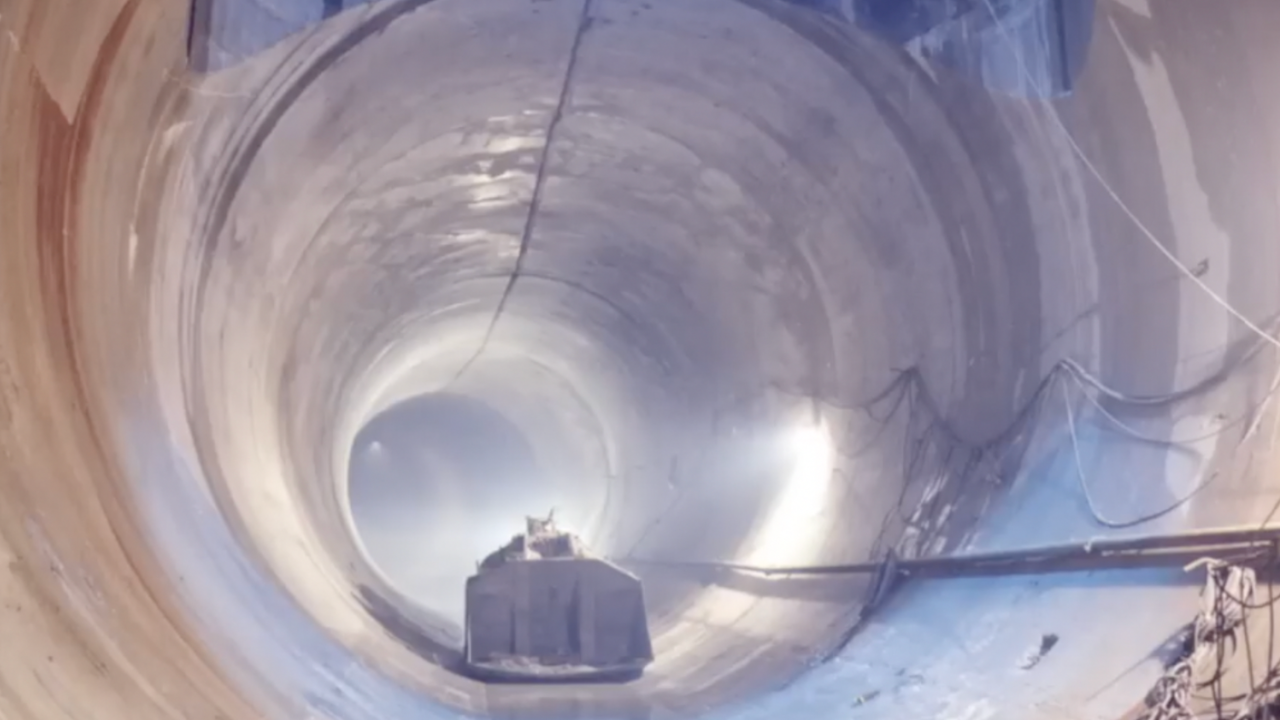


MILWAUKEE — About 320 feet under the streets of Milwaukee, a vital piece of infrastructure snakes beneath the city. It can hold hundreds of millions of gallons of water and helps keep our rivers and Lake Michigan free of pollution. I'm talking about the Milwaukee Deep Tunnel.
As I traveled below the city to learn more about the tunnel, I didn't go down in an elevator. Instead, there is a sign that calls it a 'personal hoist to surface structure'. Not an elevator, apparently.
When I finally made the 320-foot journey, I stepped off the 'personal hoist' and into the pumping station. More on that in a moment. While I would have loved to be taken into the tunnel, that would have been logistically difficult. The tunnel is currently holding hundreds of millions of gallons of sewage water. I'd be scuba diving through your waste water. Two problems with that: I don't have a scuba license, and I don't want to swim through sewer water.
The Milwaukee Deep Tunnel can hold about 521 million gallons of water. It's operated by the Milwaukee Metropolitan Sewerage District (MMSD).
Watch: Going 320 feet underground to explore the Milwaukee Deep Tunnel's pumping station
“When the treatment plants are maxed out or nearing capacity, the water level will rise in the sewers and spill into the deep tunnel, while some of it continues toward the treatment plants. So we’re cleaning water at the same time as we’re starting to store water in the tunnel," Bill Graffin, the public information officer for MMSD, said.
That water remains in the tunnel until the treatment facilities can catch up with the high water volume. The tunnel is intended to help during periods of intense rainfall, as we had on April 14th and 15th, or during the August floods. The pumping station, where I visited, houses the motors that power the pumps that transport the water from the tunnel to the treatment facilities. There are a total of three pumps. Each one can handle about 70 million gallons of water a day.
A monitor displays how the Deep Tunnel and pump room are operating. When I visited, the screen reported that the tunnel was holding about 285 million gallons. It also showed which pumps were being used and whether the water was being taken to Jones Island or South Shore for treatment.
“Because Lake Michigan is our source of drinking water, and it’s also a source of recreation for a lot of people, it’s great for tourism to have a beautiful lake, it’s great for health reasons, everything we do is to help protect Lake Michigan and public health," Graffin said.
The Deep Tunnel system isn't perfect. Sometimes, it rains so much that the tunnel could overflow and flood businesses, basements, and homes. To prevent that, MMSD allows some untreated water to be discharged into Lake Michigan. During the floods in August 2025, MMSD discharged about 5 billion gallons of untreated water, the largest since 1994. The most recent discharge was from the strong storms this past week. MMSD said it's still calculating the exact amount of water discharged.
Before the Deep Tunnel was built in 1993, there were about 50-60 discharges a year, resulting in 8-9 billion gallons of untreated sewage water polluting our waterways.
Thanks to the Deep Tunnel, it's only about two discharges a year.
“Since the tunnel has gone online, we’ve captured and cleaned 98.5 percent of every drop of water that has gotten into the regional sewerage system," Graffin said.
Perhaps this is just me, but when I often think about being green or environmentally friendly, my mind turns to less consumption, less building, planting trees, and cleaning litter. But actually, when you build massive infrastructure programs like the deep tunnel, you’re doing a whole lot to preserve the environment.
Side note for the brave. Rather than taking the 'personal hoist to surface structure', you can climb a ladder that will take you in or out of the tunnel. That's a 320-foot climb. To make things a bit easier, they have rest stops about every 20-30 feet.
It’s about time to watch on your time. Stream local news and weather 24/7 by searching for “TMJ4” on your device.
Available for download on Roku, Apple TV, Amazon Fire TV, and more.
