

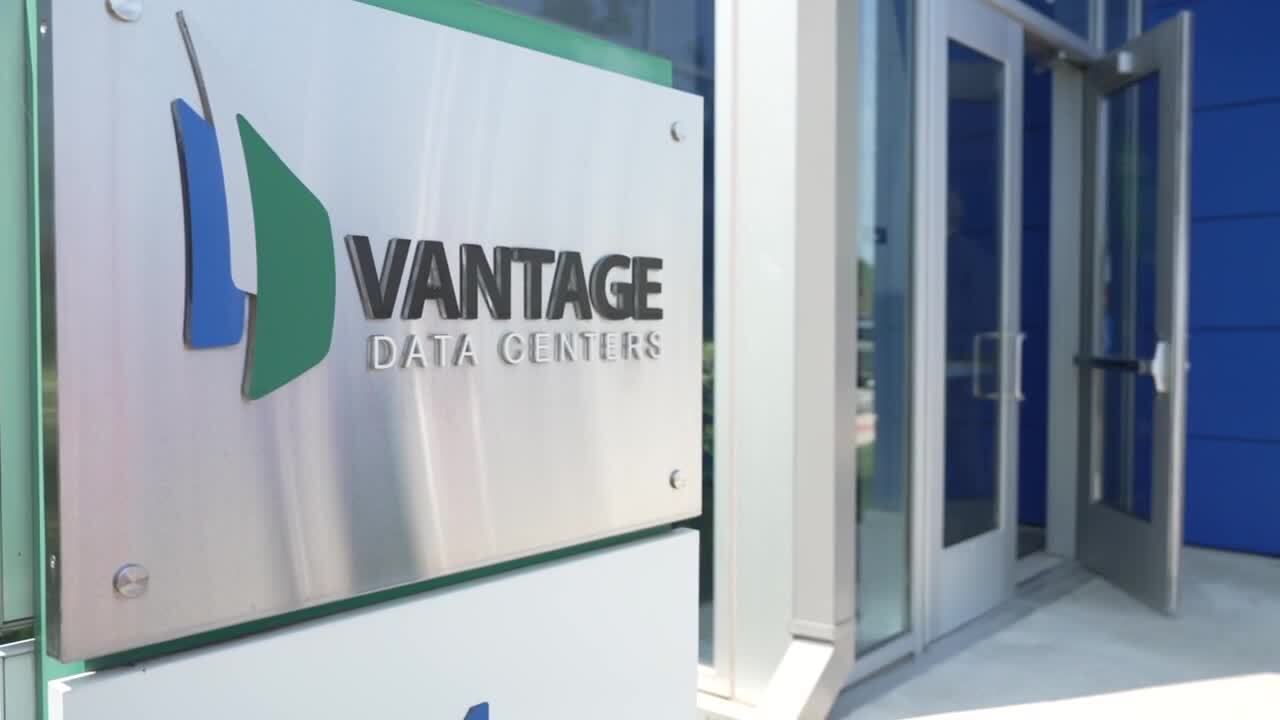



Vantage Data Centers is building a $15 billion hyper-scale AI facility in Port Washington, Wisconsin — and the question of who will pay for its enormous energy needs is at the center of an ongoing debate.
WATCH: Vantage data center energy costs: Who pays the bill in Port Washington?
Vantage says it is paying for the buildout of 2,000 megawatts of energy — including wind and solar — but says it will only need 1,400 megawatts.
During a tour of a Vantage data center in Virginia, Vice President of Site Operations Ryan Kehoe described what the Port Washington facility will require.
"So with it being more power dense, you're going to see larger electrical rooms. The layout will be very similar, but the volume will be higher," Kehoe said.
Vantage estimates it will invest $5 billion in energy infrastructure, including solar, wind and battery storage.
TMJ4's Charles Benson pressed Dana Adams, Vantage's North America president, about the scale of the project's energy demands.
"No one questions other forms of industrial development, residential development, etc. Because consumers need these things, right, and so with data centers it's no different. We're relying on data centers to support really everything that we do in our lives, whether it's our work or it's our personal lives," Adams said.
Adams also acknowledged a broader national challenge.
"The energy needs are there, no doubt, and one of the challenges is that as a country we have not invested in energy infrastructure sufficiently over the last 25 years, and now with this growth in technology there is incredible demand for more energy infrastructure," Adams said.
What ratepayers are being told
Everyday ratepayers worry their monthly bills will rise because of data centers. Vantage, state regulators at the Public Service Commission and We Energies all say that is not the case. Vantage is paying its share of buildout costs and for its energy needs through utility tariffs — the rate charged to large customers.
When asked how Vantage provides accountability and transparency that customers will not pay the bill, Adams pointed to the tariff (rate charges) structure.
"I think the tariffs are a great way to do that, and I do think Wisconsin has been forward leaning in that, really setting a great example that the rest of the country can follow to ensure that people are actually protected," Adams said.
We Energies spokesperson Brendan Conway echoed that position.
"No costs to serve data centers will be shifted to other customers," Conway said.
Conway said the utility's legal obligations and the structure of the data center rate make the arrangement transparent.
"Legally, we have to charge all customers for their usage, no more and no less. And on top of that, as part of this data center rate, it shows very clearly, data centers have to pay their full costs," Conway said.
When asked what he would say to people who are not willing to take the utility's word for it, Conway said the information is publicly available.
"It may not be exactly the way people want it, but the way that it is set up in this state is it's incredibly transparent. And by the way, it is on websites. It can be looked at," Conway said.
Both regulators like the Public Service Commission and intervenors like the Citizens Utility Board can request and audit the data themselves.
Environmental and consumer group concerns
Not everyone is satisfied with those assurances. Amy Barrilleaux, communications director for Clean Wisconsin, said the scale of the project is unlike anything the state has seen.
"More energy than 1.3 million Wisconsin homes. We've never seen anything like that before," Barrilleaux said.
Barrilleaux said the issues surrounding the facility are deeply interconnected — water use, power generation and construction — and that energy infrastructure remains the top concern for neighbors and environmental groups.
"All of these power plants are going to need power for cooling. We need to think about ok, that's just in Wisconsin. But what's happening across the region. So there's a lot to talk about here. These are really complicated issues," Barrilleaux said.
The PSC has said power bills will not go up because of data centers. However, bills could still rise for unrelated reasons — a distinction that has added to public confusion.
Oracle lawsuit adds uncertainty
Oracle is involved in a lawsuit against state regulators over tougher financial metrics. Oracle is being asked to meet what are called collateral requirements to cover infrastructure costs — not ratepayers. Consumer groups like the Citizens Utility Board wanted those requirements in place to protect ratepayers and worry the lawsuit could weaken them.
"This is something that Oracle will work through with the PSC and with the utility," Adams said. "They'll need to comply with what those requirements are under the tariff. And so really it is between them and the PSC and the utility."
Transmission costs still unresolved
As for $1.5 billion in transmission costs — the high-voltage lines needed to move all that power — Vantage says it will pay its share. Consumer groups are still waiting for state and federal regulators to sign off on safeguards protecting ratepayers.
Adams said transparency and accountability remain priorities for the company.
"I think we want to be transparent and we understand that we need to be accountable," Adams said.
This story was reported on-air by Charles Benson and Alex Gaul and has been converted to this platform with the assistance of AI. Our editorial team verifies all reporting on all platforms for fairness and accuracy.
It’s about time to watch on your time. Stream local news and weather 24/7 by searching for “TMJ4” on your device.
Available for download on Roku, Apple TV, Amazon Fire TV, and more.
