

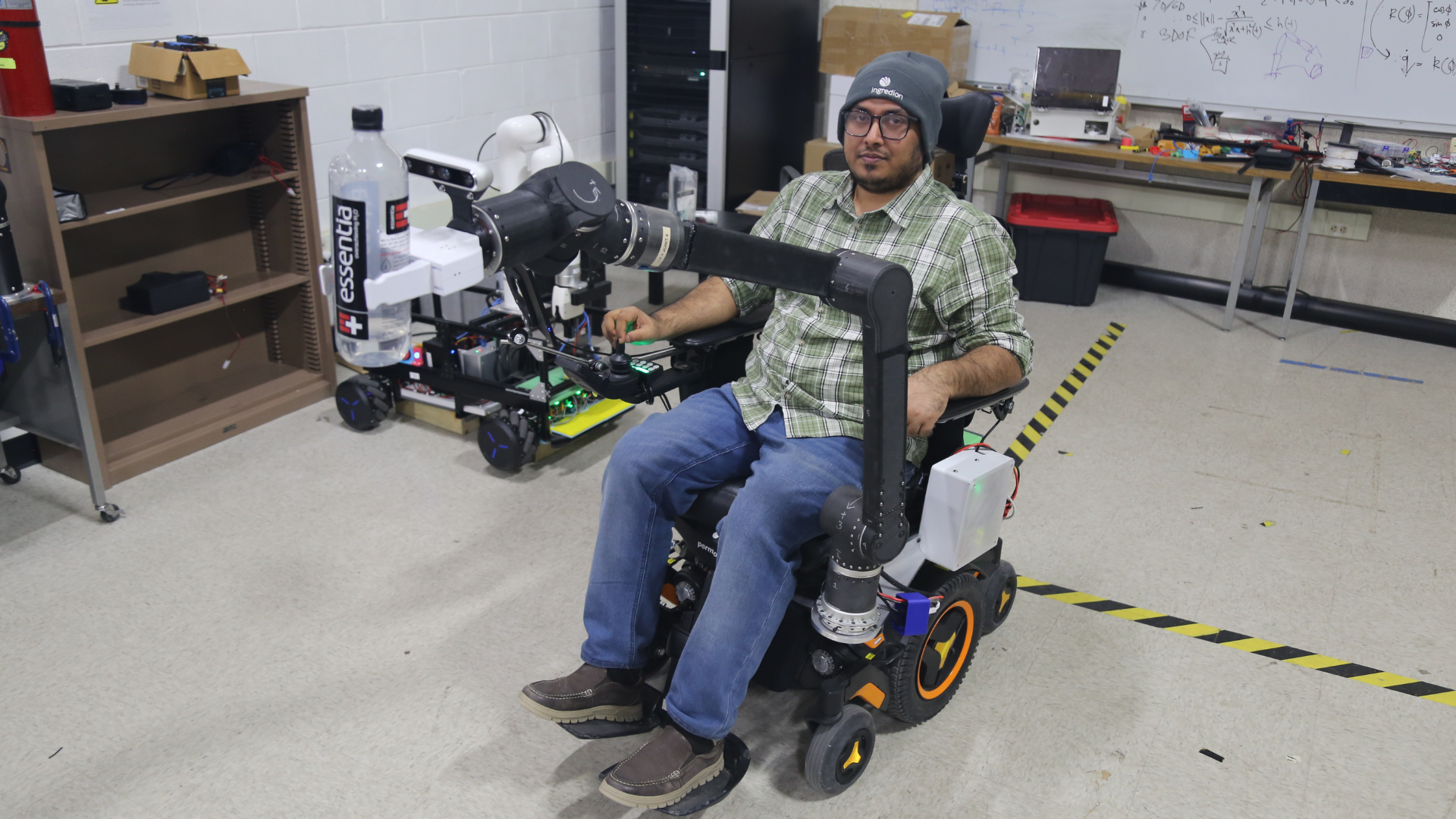


GLENDALE — Researchers at UW-Milwaukee are developing a robotic arm attachment for wheelchairs that could significantly improve the quality of life for individuals with mobility limitations.
Since 2020, a team of PhD students led by Professor Habib Rahman, PhD, the chair of the mechanical engineering department, has been developing methods to give people who use power chairs more independence. That tool is a robotic arm.
"So they can use this wheelchair-mounted robot for their daily activities. For day-to-day living tasks such as picking and placing an object, or helping them to eat, or opening and closing a door," Rahman said.
The arm is controlled by the same joystick that moves the wheelchair. All it takes is a simple switch to go from controlling the robotic arm to the chair. If the user doesn't have mobility in their hands, they can also operate the wheelchair with air pressure or a visual control system.
Watch the story to see the robotic arm in action...
“In terms of power wheel hair users we're trying to make our device compatible to all of them," Md Smiul Haque Sunny, a PhD candidate at UW-Milwaukee, said.
The arm minimizes the role a caregiver has to play. That allows users to accomplish more tasks on their own.
“Sometimes, even like the wheelchair users, they go for shopping, and sometimes they want to reach some like items which are a little bit up, and sometimes they will fall, so this device can reach from the ground to the kitchen top shelves," Sunny said.
Just down the hall, more PhD students are building another type of robotic arm. This one assists with upper limb physical therapy. It means P.T. can be done at home, which is especially important for those with more severe mobility limitations.
“You don’t need to think about who will be taking to the hospital because travel and transport is one of the biggest problems," Rahman said.
Trying to coordinate rides often means spending extra money for transportation or missing appointments altogether. Having an at-home physical therapy device greatly increases the chances that PT will be completed. Plus, most insurance policies put a cap on the number of sessions a patient can take. With the at-home tool, users can practice their exercises as much as they want.
“We have also done the tele-operations. So a therapist can remotely control this robot," Rahman said.
If the user is unable to move the arm, the robot can take control and dictate the movements. An added benefit of this type of physical therapy is that real-time data can be compiled to assess progress.
Each product still requires further development before it becomes commercially available. The team building the wheelchair robotic arm hopes it can pass regulatory approval and begin mass-producing the arm in about three years.
It’s about time to watch on your time. Stream local news and weather 24/7 by searching for “TMJ4” on your device.
Available for download on Roku, Apple TV, Amazon Fire TV, and more.
