

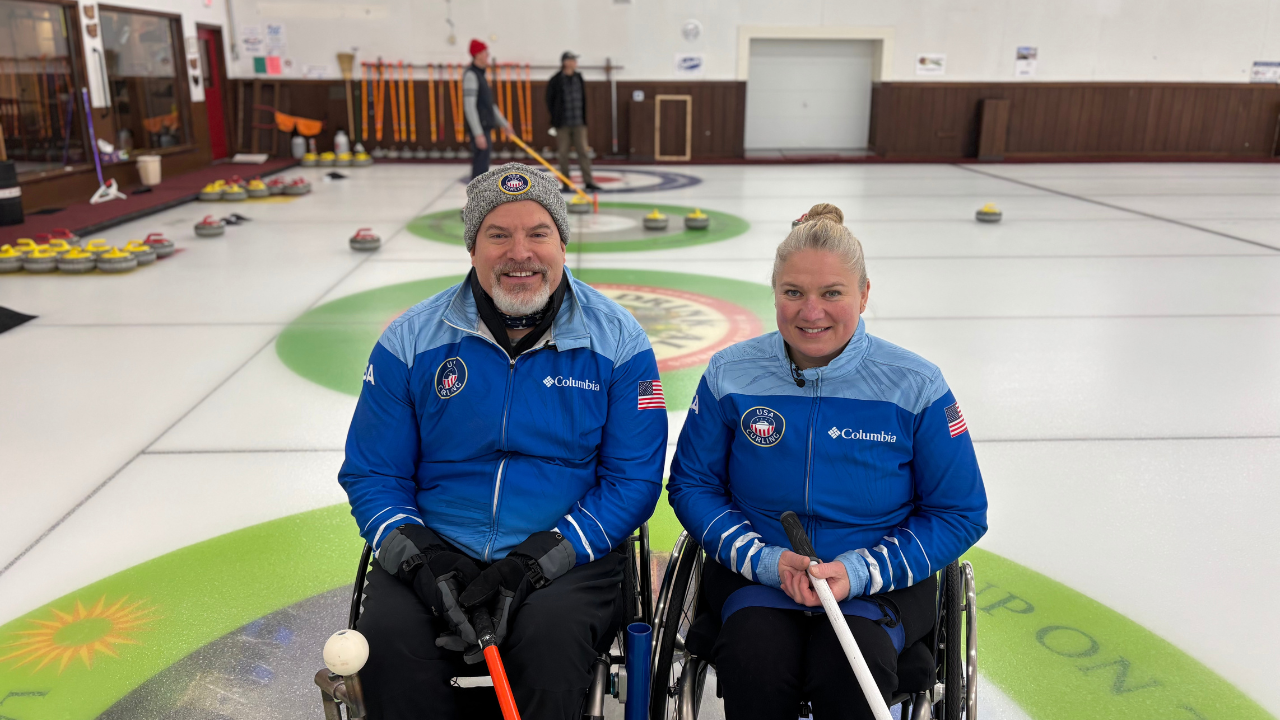


Wisconsin's Laura Dwyer and Steve Emt are making history as the first United States team to compete in wheelchair mixed doubles curling at the Paralympic Winter Games in March. The two-time national champions believe they have what it takes to bring home gold.
"It's the first time that mixed doubles is going to be introduced in the Paralympic Games," Dwyer said.
The pair has dominated the sport since teaming up, losing only one game domestically in two years. While they've faced a few more losses internationally, their track record speaks for itself. They secured their spot at the Paralympics by winning the trials in South Dakota.
"In two years, we've only lost one game domestically. Internationally, a couple more, but we're the two-time national champions now. Went to South Dakota, winning the trials there," Emt said.
Both athletes found their way to Paralympic curling through life-changing tragedies that left them paralyzed.
Dwyer was working as a landscaper and raising two young boys when her life changed forever in May 2012. A freak accident involving a 1,000-pound tree branch falling 40 feet broke her back in 26 spots, leaving her paralyzed with a spinal cord injury at T-12.
Watch: Wisconsin curling duo makes history as first US team in Paralympic mixed doubles
"It absolutely changed my life. I was a landscaper for 18 years prior to my accident and a mom of two young boys," Dwyer said. "What am I gonna do. What will my life look like moving forward? How am I gonna to be a mom? How am I'm going to earn a living? How am I gonna manage in a wheelchair?"
Emt's story began with a drunk driving accident when he was 25. The former University of Connecticut basketball player was traveling about 100 miles per hour on the highway around 2 a.m. when he passed out behind the wheel. His truck went off the road, cartwheeled, and rolled about 70 yards. He was ejected from the vehicle and woke up to doctors telling him he would never walk again.
"I woke up, and I was told you're never gonna walk again," Emt said.
The accident sent Emt into a deep depression, where he hit what he calls rock bottom.
"There was a month after my crash where I had two days where I couldn't get out of bed, and I wasn't feeling up, and that's when I hit rock bottom. That was my hell," Emt said. "I was allowing all of these negative thoughts about who's gonna take care of me for the rest of my life. Who's gonna want me? Who's gonna bathe me? Who's gonna feed me for two days? Everyone who came into my room, I was throwing stuff at them, I would scream at them, yell at them, swear at them. Get out of my room, I don't want to be here. And I thought about doing harm to myself."
Now, 31 years after his accident and 12 years after Dwyer's, both athletes are focused on the gold medal that could cap off their remarkable journeys.
"When we get the gold medal wrapped around our neck, it's not going to be about that moment right there. It's not going to be about that game; it's going to be about the last 31 years for me and the last 12 years of getting knocked down. Whether it's on the ice or in life, but you know what, we keep on going. We keep battling, we pick ourselves up," Emt said.
This story was reported on-air by a journalist and has been converted to this platform with the assistance of AI. Our editorial team verifies all reporting on all platforms for fairness and accuracy.
It’s about time to watch on your time. Stream local news and weather 24/7 by searching for “TMJ4” on your device.
Available for download on Roku, Apple TV, Amazon Fire TV, and more.

