

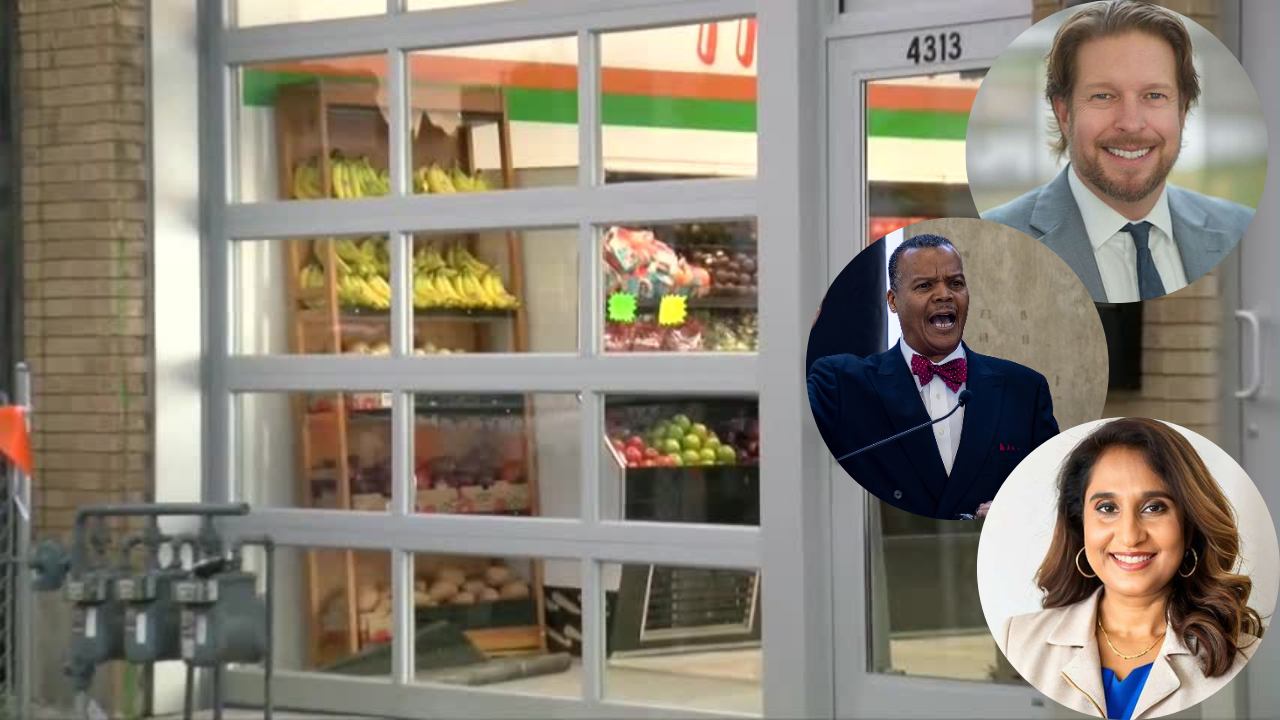

In parts of Milwaukee, buying fresh groceries isn't a simple errand—it's a challenge shaped by distance, transportation and long-standing inequities.
As neighborhood grocery stores continue to close, more residents are finding themselves living in “food deserts,” places where access to healthy, affordable food is limited or nonexistent.
Watch: Neighbors adjust shopping plans after Milwaukee Sentry on Silver Spring announces closure
“A food desert is actually kind of a description of a location, typically that lacks fresh food and healthy foods,” Dr. Kirk Harris, associate professor of Urban Development at UW–Milwaukee, said. “Access to those foods are difficult to secure simply because often the institutions or stores that may be in communities aren't serving or providing for those fresh foods. And those fresh foods are very much linked to health outcomes in communities.”
According to the Near West Side Food Access Project, there were 13 food deserts in Milwaukee County in 2015.
Dr. Christopher Simenz, a public health expert with the Medical College of Wisconsin, said roughly one in five Milwaukee residents lives in what would be considered a food desert.
"The reality is, we've got groceries closing, specifically on the north side of Milwaukee, at an alarming rate," he said. "And we're seeing that number growing."
Watch: Milwaukee neighbors wonder where they’ll shop next after ALDI closure
Prasanta Anumolu, a community development educator with UW Extension in Milwaukee County, said even the term “food desert” may fall short.
“The term food desert sometimes implies that this is a naturally occurring phenomenon,” Anumolu said. “But it’s not. There’s a woman named Karen Washington who coined the term ‘food apartheid’ to better explain that these conditions are the result of long-term policies, historic redlining and deliberate decisions.”
Segregation drives the problem
Harris said the prevalence of food deserts in Milwaukee reflects deeper systemic issues.
“And the reason that Milwaukee has probably so many food deserts is indicative of the fact that it is one of the most highly segregated places in America,” Harris said. “Segregation is a major factor for all kinds of inequalities manifesting itself.”
Simenz echoed that point, noting food access cannot be separated from housing, income and stability.
“So if we see people and households that are food insecure in Milwaukee, it's often because they're having to make trade-offs, really,” Simenz said. “They have to decide whether or not they're going to pay for rent.”
Milwaukee’s housing challenges, Simenz said, frequently compound food access problems.
“Evictions, housing instability and repeated displacement disrupt employment, education and access to food all at once,” he said. “These issues don’t exist in isolation — they stack on top of each other.”
Harris said displacement also reinforces segregation.
“When people are pushed out of neighborhoods, communities become even more segregated,” he said. “And that perpetuates the problem.”
Transportation adds another barrier
Transportation plays a major role in whether residents can reach healthy food options.
“You can have a grocery store a mile away,” Harris said, “but if you don’t have a car and you’re buying groceries for a family, that distance becomes a serious obstacle.”
Anumolu noted that the USDA defines food deserts using proximity because “not everybody has access to a car.”
“That half-mile or mile matters,” she said. “It’s a measure of what’s realistically walkable.”
Simenz noted that access to public transportation doesn't necessarily fix the problem.
"Try taking three buses with two transfers with kids to get to the grocery store," he said. "And think about how that ice cream in your grocery container is going to look when you've taken three buses, traveled across town and done that, right?"
Earlier this year, the Milwaukee County Transit System adjusted multiple routes while addressing a $14 million budget gap.
“Any time reliable transportation routes change or shrink,” Simenz said, “we tend to see disruptions in food access.”
Cost is another factor
"A lot of communities that are experiencing these issues of food deserts are also economically vulnerable," Harris explained. "And so the fact that individuals then have to pay for transportation, that just is another cost and potential barrier to actually securing the food."
MCTS increased fares in 2026, raising the cost of a single ride from $2 to $2.75.
"People far too often think of geography and don't think of cost, because food can be next door and be inaccessible if it's too expensive," Simenz said. "So if we go to the full service markets that we see in plenty of the designer and boutique markets that line the rings outside of the city, where milk can cost between five and $10 a gallon, where pre-chopped fruit can cost us $10 a pound, right? These are luxuries for some people. They're not options for most."
Health impacts compound the problem
When full-service grocery stores disappear, the health effects extend far beyond inconvenience.
Harris noted that there is a term for areas with access to food, but not access to fresh, healthy food — food swamps.
"That is, those places where they have high levels of fast food, cheap food stuff, you know, stuff you really shouldn't be eating on a regular basis, right?" Harris said. "And this is what shows up in these corner stores, and you know, these gas station stops and all of these places that have food, but it's not very healthy food."
Simenz said this leads not only to hunger, but to poor nutrition.
“You can have enough calories and still be nutritionally insecure,” he said.
Community solutions emerge
Despite the challenges, community-based solutions are taking shape.
“Support the stores that are there,” Anumolu said. “Grocery margins are incredibly thin, and community support is essential to keeping doors open.”
Watch: Sherman Park Grocery Store pleads for help to stay open
Sherman Park Grocery, which opened in 2022 in an area designated as a food desert, is one example.
The store recently added a new cooler through partnerships with MCW and Feeding America, allowing it to offer grab-and-go healthy options like salads, sandwiches and fruit cups.
“That’s responding directly to what the community said they needed,” Anumolu said.
Simenz said mobile markets, food pantries and community food centers are also critical — especially when they offer education alongside food.
Organizations like NourishMKE, Feeding America Eastern Wisconsin and Hunger Task Force, he said, help fill gaps when grocery access is limited.
A community-wide issue
Even for residents who don’t experience food insecurity personally, Simenz said the impacts ripple throughout the entire city.
"It impacts everything. If you go to the most basic, let's think about participation in the economy, right, which is this basic driver of an American capitalist society," Simenz said. "If you've got people that cannot eat, you've got people that are going to, by necessity, be less productive, right? Because employment is going to be impacted, transport to and from employment is going to be impacted. We already talked very briefly about education is going to be impacted."
Harris said solving food deserts requires multiple approaches — from immediate access solutions to long-term policy change.
"We've got to figure out how we can create better incentives for retailers, food retailers to come into communities that have historically been segregated and disadvantaged," Harris said, adding that the government will also need to play a large role in the solution.
Simenz agreed, emphasizing that food insecurity is not about personal failure.
"There are real people that don't have healthy food to eat," Simenz said. This isn't about personal choices. This is about systems that create inequitable access or create lack of access...until we prioritize people being healthy and having enough to eat and having healthy food to eat, we're going to continue to have problems."
It’s about time to watch on your time. Stream local news and weather 24/7 by searching for “TMJ4” on your device.
Available for download on Roku, Apple TV, Amazon Fire TV, and more.

