

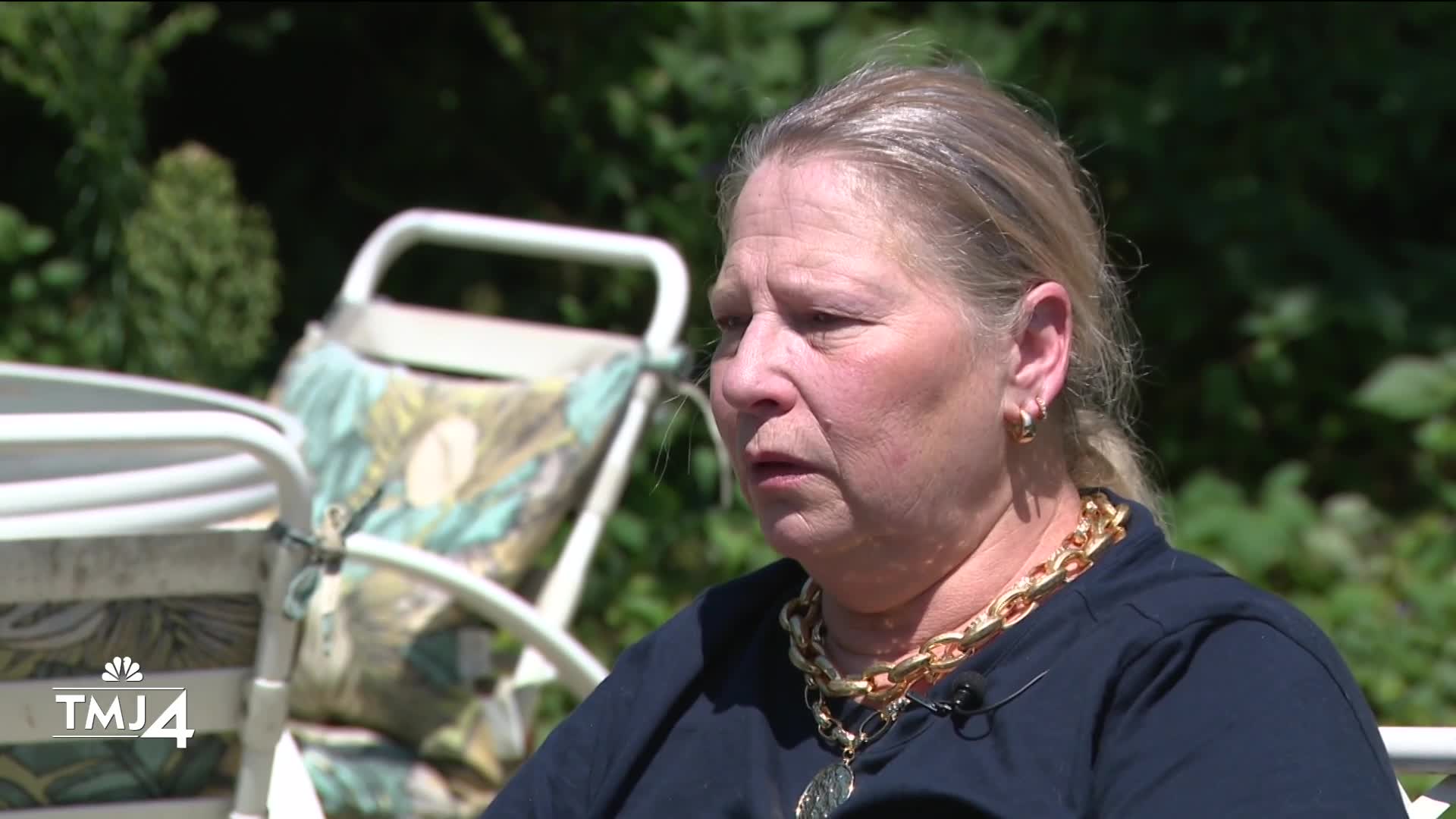


GLENDALE — Paula Palmese is scared. Her husband, Richard, is set to be released from prison Aug. 11 — and she says he has already proven he won't follow the no-contact order meant to keep her safe.
Court documents obtained by TMJ4 News show Richard is behind bars on strangulation and suffocation charges. While incarcerated, he sent Palmese letters in violation of a court-ordered no-contact order.
"He sent me a letter. December 11th, and then again December 18th. 'I love you. I can't wait to get back to you. Can't wait to take you to Paris...'" Palmese said.
Palmese reported the letters to police, and Richard has since been charged again for the violations. But his sentence ends Aug. 11, and she says he will be free for at least 9 days before being sentenced on the new charges.
Watch: Woman fears for her life as husband set for release from prison after violating no-contact order
When asked whether no-contact orders and restraining orders make her feel protected, Palmese's answer was direct.
"No," Palmese said.
The fear has upended her life.
"I fell apart. I quit my job. I have been living in hiding," Palmese said.
Her greatest fear is stark.
"He's going to kill me and my son," Palmese said.
The consequences of broken or denied protection orders have proven deadly in the area. In Kenosha, Makayla Plaza was killed by her estranged husband after her restraining order request was denied. In St. Francis, Kiana Pliska was shot and killed 8 hours before a judge granted her restraining order. In West Milwaukee, a man with a no-contact order broke into his ex-girlfriend's home and stabbed her and her new boyfriend, killing Jose Valdivia.
Shawn Muhammad, a director at Asha Family Services, a domestic abuse resource center in Milwaukee, said the circumstances surrounding Palmese's situation raise serious red flags.
"It would seem as if, especially if it's a situation where he's incarcerated for domestic violence and he's willing under supervision to violate a no-contact order — that would send risk factors through the roof," Muhammad said.
Muhammad offered advice for survivors in similar situations.
"I would find a hotel or find somewhere else to be rather than my address where he could not find me," Muhammad said.
Palmese said she came forward hoping to expose what she believes is a system failing survivors across the state.
"Nobody should put their hands on you. Nobody. And if I can help one person that can hear this, then I won," Palmese said.
This story was reported on-air by a journalist and has been converted to this platform with the assistance of AI. Our editorial team verifies all reporting on all platforms for fairness and accuracy.
It’s about time to watch on your time. Stream local news and weather 24/7 by searching for “TMJ4” on your device.
Available for download on Roku, Apple TV, Amazon Fire TV, and more.

