

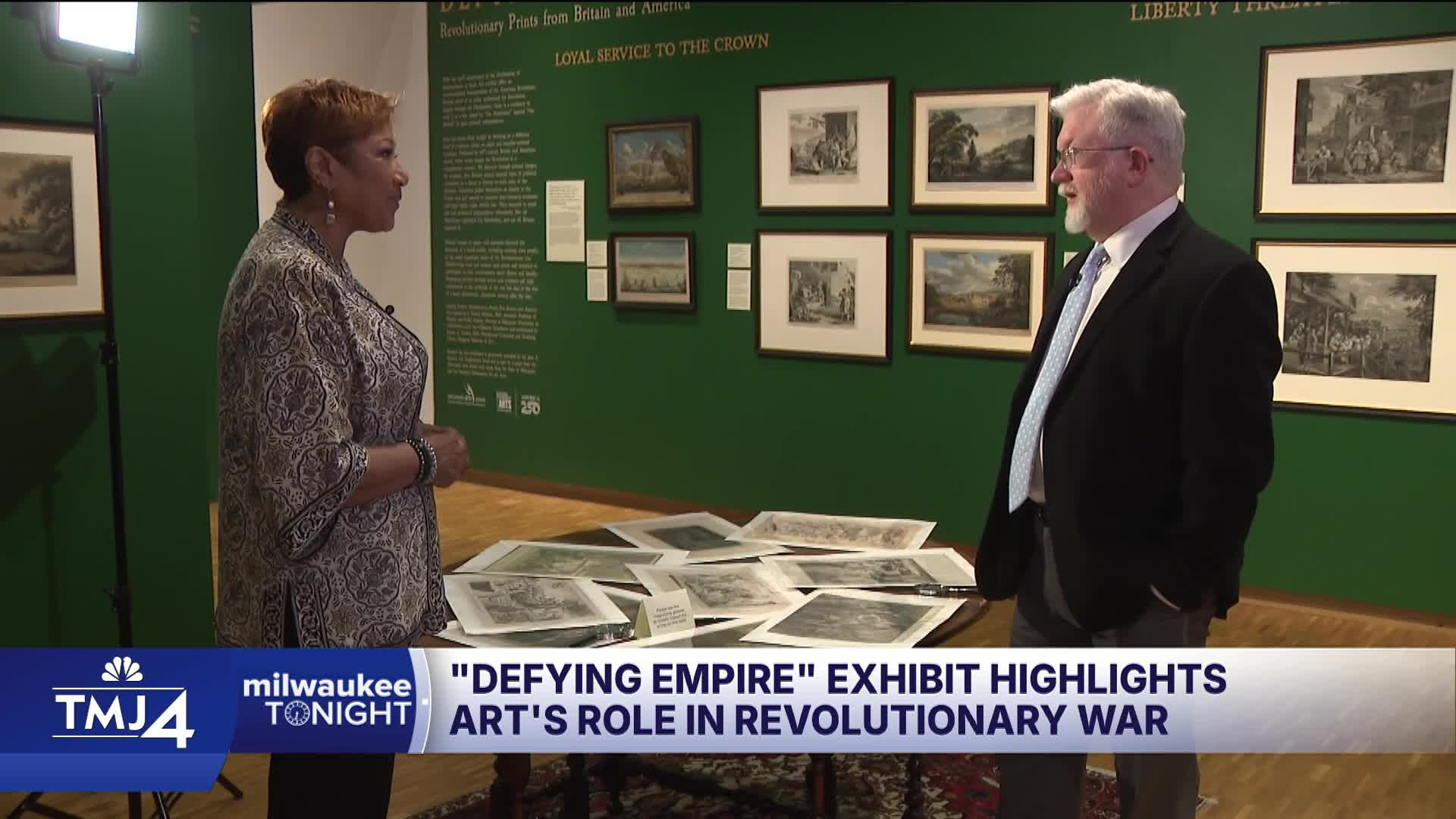


MILWAUKEE — As the United States celebrates the 250th anniversary of its founding, the Haggerty Museum of Art is inviting visitors to see the American Revolution through a different lens. Defying Empire: Revolutionary Prints from Britain and America, curated by Marquette University history professor Dr. Patrick Mullins, explores how prints, ceramics and other everyday objects shaped public opinion on both sides of the Atlantic.
"A lot of the art objects in this exhibit were manufactured in Britain and many of them were made for British consumers," Mullins said. "You get a different perspective on the Revolution by looking at these objects."
The exhibition challenges the traditional view of the Revolution as simply Americans versus the British. "We Americans tend to think of the American Revolution as a war between the Americans and the British," Mullins said. "It was actually a civil war in which Americans were on both sides, but also British people on both sides." Through more than 20 prints, transfer-printed ceramics and other artifacts from the Haggerty Museum of Art and the Chipstone Foundation, the exhibit illustrates the political debates that divided people across the Atlantic.
Watch: 'Defying Empire' offers new perspective on the American Revolution
Mullins also wanted to highlight the often-overlooked role women played during the Revolutionary era. While they were excluded from formal political institutions, women found other ways to express their views. The exhibition includes prints depicting women organizing tea boycotts and participating in political protests, along with ceramics bearing political messages. "She can't speak out in parliament or the legislature, or even write in a newspaper," Mullins said. "But she can buy the ceramics that send radical political messages. Then, when she has her friends and neighbors over the house, she pulls out her political tea set and they have a conversation."
The exhibition coincides with America 250, the national observance of the country's semi- quincentennial. Mullins hopes the anniversary encourages people to reflect on the enduring ideals expressed in the Declaration of Independence. "Those opening lines, 'All men are created equal,' are a statement of broad principles, universal human rights that apply to all people and all times and places," he said. He noted that leaders including Frederick Douglass, Abraham Lincoln, and Susan B. Anthony later used those ideals to push the nation toward greater equality.
For Mullins, who traces his love of early American history back to the nation's Bicentennial celebration in 1976, the exhibition is an opportunity to spark new conversations about the country's founding. "It's the Declaration that makes even people that are new immigrants American," he said. "If they embrace this creed and they live it, then they are as American as anyone." Defying Empire demonstrates that the American Revolution was shaped not only by soldiers and statesmen, but also by artists, consumers and ordinary citizens whose voices still resonate 250 years later.
Defying Empire: Revolutionary Prints from Britain and America // Haggerty // Marquette University
It’s about time to watch on your time. Stream local news and weather 24/7 by searching for “TMJ4” on your device.
Available for download on Roku, Apple TV, Amazon Fire TV, and more.
