

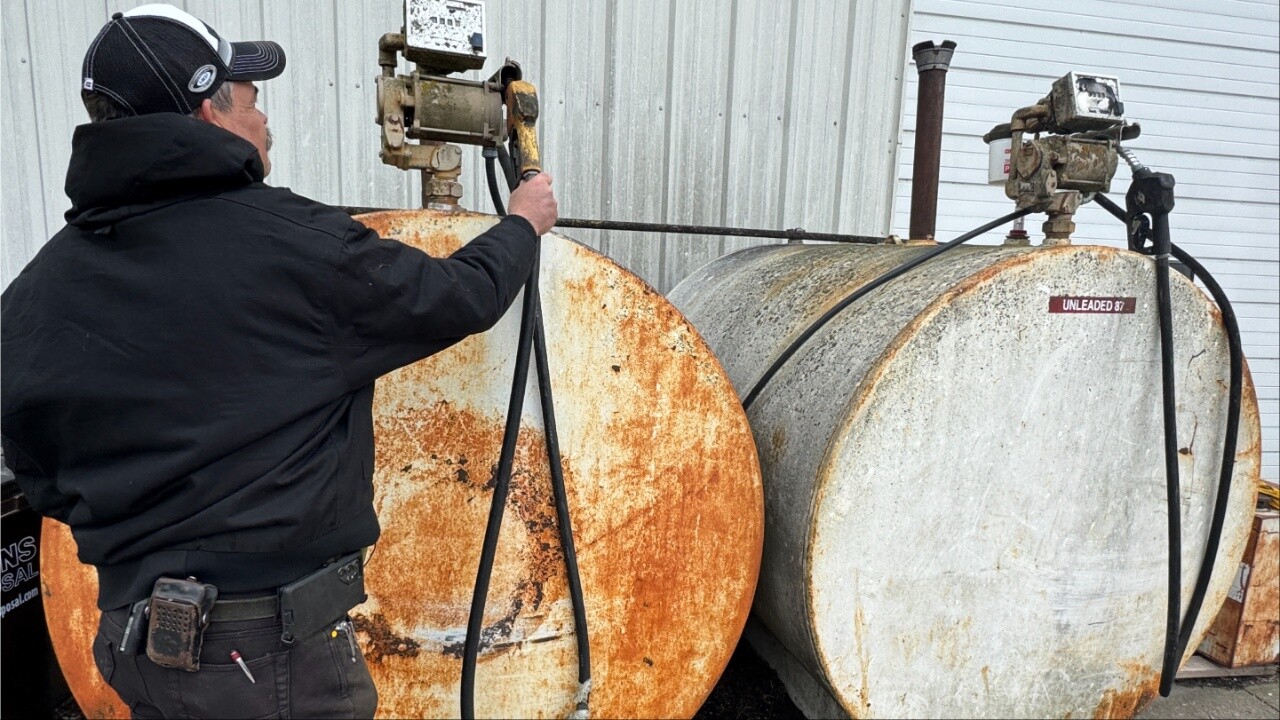


DELAFIELD, Wis. — A Delafield farmer says rising diesel prices are cutting into his bottom line and could impact grocery store prices for Milwaukee-area families and beyond.
Jim Renn and his family farm about 800 acres of corn, soybeans, wheat and hay in addition to raising 200 beef cattle. Almost every aspect of running his operation depends on diesel.
“Our biggest tractor is 300 horsepower, and that fuel tank in there is about 125 gallons,” Renn said. “If you think about diesel fuel at $5 a gallon times 125, everybody can do the math. It's not a cheap date.”

According to AAA, the average price for diesel in the Milwaukee/Waukesha area is $5.24 per gallon, up 25 cents from a week ago. Regular unleaded gasoline averages $4.30 per gallon. Nationally, diesel is $4.39 and regular unleaded is $3.94. The record for diesel was $5.52 back in June of 2022.
Watch: Fuel costs hitting Wisconsin farmers hard during planting season
Renn says he relies primarily on what’s known as off-road diesel — a dyed fuel used for equipment that isn’t driven on highways. The red dye distinguishes it from on-road diesel sold at gas stations, which includes a road tax used to maintain highways. Off-road diesel is slightly cheaper, but still subject to other fuel taxes.
“This is off-road diesel, so it’s red in color, red dye,” Renn said. “You cannot burn it in a commercial truck or a personal pickup truck that's diesel because it doesn’t pay road tax… Off-road diesel does not have the road tax on it, so it's basically a few cents cheaper than road fuel.”

Even with off-road savings, filling up costs him thousands of dollars every two weeks. He says during the busiest weeks of planting season, he’ll fill his largest tractor twice a day. Each top-off means more money leaving the farm to cover fuel costs.
Standalone costs aren’t the only problem. Renn says the market prices for the corn and soybeans he grows are set daily on the Chicago Board of Trade, not by him. That means if fuel expenses spike, he can’t raise his crop prices to offset the increase.
“We can't set our price,” Renn said. “So with fuel prices being up, it costs me more to produce without being able to earn more.”
The effects extend beyond his fields. Renn says diesel prices hit the transportation industry hard. Nearly all farm products are transported by truck to warehouses, processors or retailers — and freight companies pass those higher fuel charges along.
“Everything is moved with a semi, and that semi has to pay for fuel,” he said. “In the end, U.S. consumers are going to have to pay more.”

Looking ahead, the U.S. Department of Agriculture’s Economic Research Service expects grocery prices to keep climbing in 2026, even though the pace will be slower than in recent years.
Food‑at‑home prices — the items you buy at the grocery store — are projected to rise between 1.3 percent and 2.4 percent, while dining out could cost 2.9 percent to 3.6 percent more. ERS economists point to volatile energy prices, transportation fuel costs like diesel, supply chain disruptions and global commodity markets as factors that could push food prices higher — the same costs farmers such as Jim Renn are facing now. That means the pressures hitting farms may continue to show up on store shelves throughout this year.
Renn says the pinch on producers could get worse if prices keep climbing, forcing him to put off equipment upgrades or efficiency improvements that could otherwise help his yields.
“It’s going to affect all of us in costing more, and it affects me as a farmer just as much as everybody else,” he said. “I just hope we can get to a point where we can operate on a more level playing field.”
For now, he says he’s tightening the farm budget. That means making do with older tractors, delaying new investments and keeping a close watch on every input cost — from diesel to fertilizer, which is also tied to petroleum prices.
Renn says the bottom line is simple: higher diesel costs on the farm can eventually show up in every grocery cart.
It’s about time to watch on your time. Stream local news and weather 24/7 by searching for “TMJ4” on your device.
Available for download on Roku, Apple TV, Amazon Fire TV, and more.
