

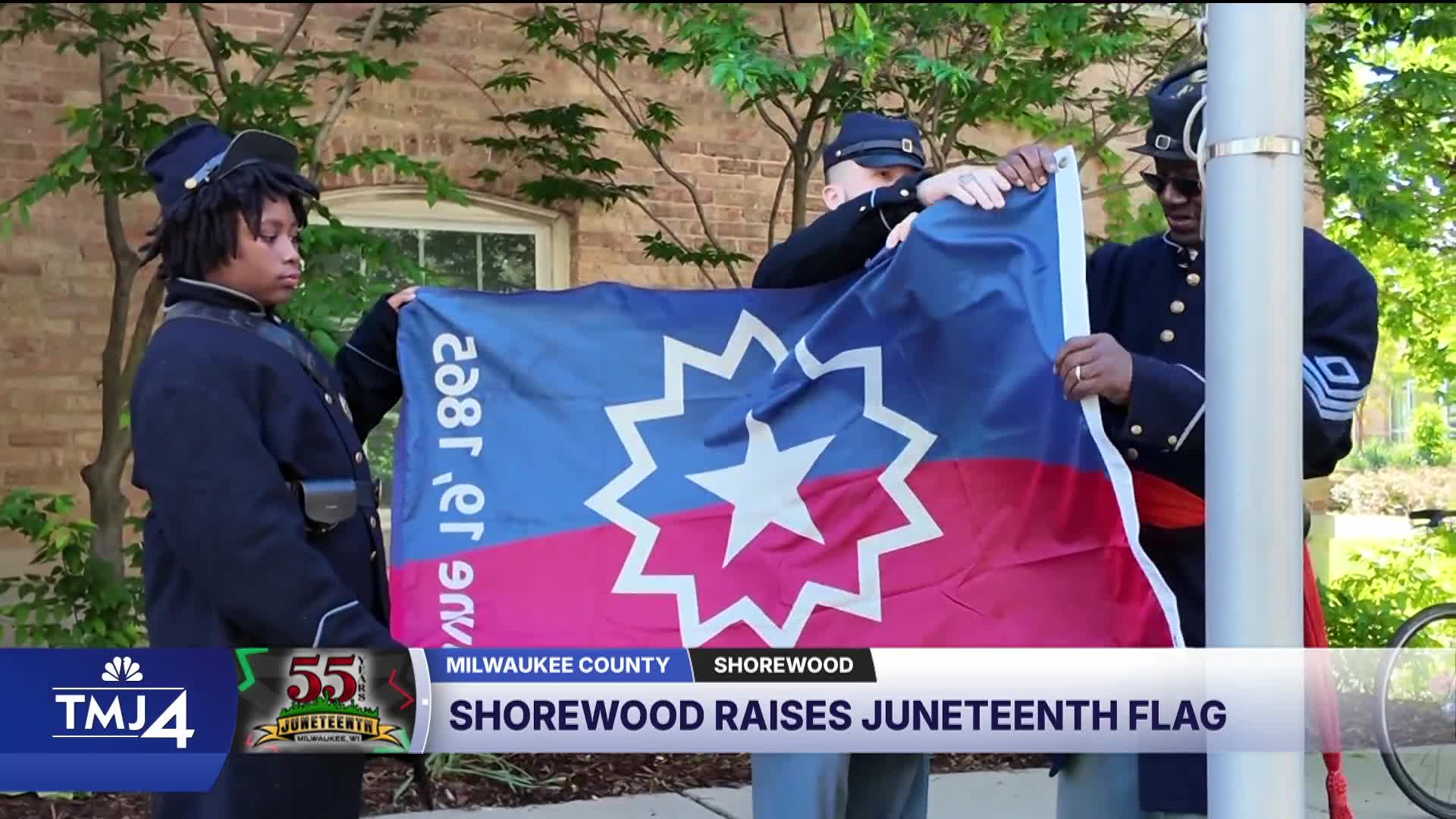


The Juneteenth flag rose over Shorewood Village Hall on Thursday as the village marked the holiday with a community flag raising — and a reminder of a history that took years to reach those it impacted most.
Shorewood is one of the few municipalites in Milwaukee County to recognize Juneteenth as a paid holiday for employees. Village Clerk Toya Harrell said that distinction carries meaning.
"It says a lot, and it says that we walk the walk, and you know it's not just talk about equity and inclusion; we're actually out there doing what's necessary to provide equity and inclusion," Harrell said.
Harrell said she was surprised to learn Shorewood was leading the way rather than following.
"It does, and it feels weird because it's Milwaukee, right? So I automatically assumed that it was done and we had to catch up, and I had no idea that we were actually starting the path for hopefully other municipalities to follow," Harrell said.

Among those helping tell the story at the event were members of Company F of the 29th U.S. Colored Troops. The reenactment group says its mission goes beyond parades and battlefield events.
"More than just parades and battlefield reenactments, education is one of the main focuses of our group," re-enactor Ricky Townsell said.
Townsell said many people are unaware that Black soldiers from Wisconsin fought in the Civil War —including himself, before he joined the group.
Watch: Shorewood raises Juneteenth flag as Milwaukee County's only municipality with a paid holiday
"I never knew that there were black people from Milwaukee fighting in the Civil War, let alone black people fighting in the Civil War, so it was news to me. So I figured it would be news to everybody else too," Townsell said.
For Townsell, Juneteenth is personal.
"It's our 4th of July. We celebrate the 4th of July simply because we're Americans and we fought and died in every conflict that this country has ever had, but it gets personal when we start talking about Juneteenth Day and our personal resurrection day when we were legally freed," Townsell said.

Townsell also reflected on what he hopes people take away from seeing the re-enactors at events like this one.
"A little piece of me, a little piece of my soldiers, a better understanding and appreciation for the price that black people paid in the preservation of the Union, it was just as great, if not greater than our white counterparts. So if they can take that away, we were successful," Townsell said.
Townsell said Shorewood's recognition of the holiday stands out, particularly given the makeup of the community.
"This is obviously a predominantly white community, and the fact that this community respects and represents a day that is important to the black community. I think it speaks volumes to the city of Shorewood, so I say kudos to them, and I'm glad they're doing it, and I can't wait to be a part of it next year, and hopefully other municipalities will pick up the banner," Townsell said.
Charlie Rosenberg, chaplain and historian for Company F of the 29th U.S. Colored Troops, said the history of Juneteenth belongs to everyone.
"In the spirit Dr. Carter G. Woodson originally intended, we're not talking about separate histories. The histories of people who are classified as white and people who are classified as black have always been intertwined, even though people wanted to deny it and everybody depended on each other. We need to understand this was a joint effort, even if it wasn't always given joint credit," Rosenberg said.

Rosenberg also explained why Juneteenth holds the significance it does in the broader arc of American history.
"The Emancipation Proclamation meant nothing until the bayonets of the United States Army were there to enforce it. Juneteenth was one that was more prominently celebrated in other areas, and it's come to encompass all of those celebrations. It was the last place where the soldiers had to arrive, announce, and enforce the Emancipation Proclamation. So Juneteenth culminates the entire process," Rosenberg said.
Harrell said the holiday also offers a lesson about why difficult history must be preserved, not set aside.
"Well, history has good and bad points, so you can't just take out the bad points because that's how you learn and that's how you grow and so when you see what we have come from, you can appreciate the path that we're going in advancement," Harrell said.
Harrell said Wisconsin's own connection to that history is something residents should take pride in.
"Take away the beauty of it and also be proud of the fact that Wisconsin played a part in our emancipation and that they were there during the time that the last state was informed about it, and you take pride in even in our city that we had troops that went down there and witnessed what happened and brought that back," Harrell said.

Organizers said one of the most meaningful parts of the day was seeing young people show up to learn and carry the story forward.
"It makes me feel so good because it means that the story is gonna continue and it's not gonna end with us old people, that we got a next generation that's gonna bring it and that's how you keep history intact, is that you pass it down from generation to generation," Harrell said.
Harrell said the flag flying over Village Hall represents more than a symbol.
"It's important that our story gets told right along with the Independence Day story because that is truly our Independence Day," Harrell said.
Youth participant Bryant Porter Jr., who stood alongside the re-enactors during the event, said he was here for a clear reason.
"So we can represent our ancestors who fought for our freedom," Porter said.
Porter summed up what the day means for the next generation in a single thought.
"So we all know our history and know how great we are," Porter said.
It’s about time to watch on your time. Stream local news and weather 24/7 by searching for “TMJ4” on your device.
Available for download on Roku, Apple TV, Amazon Fire TV, and more.
