

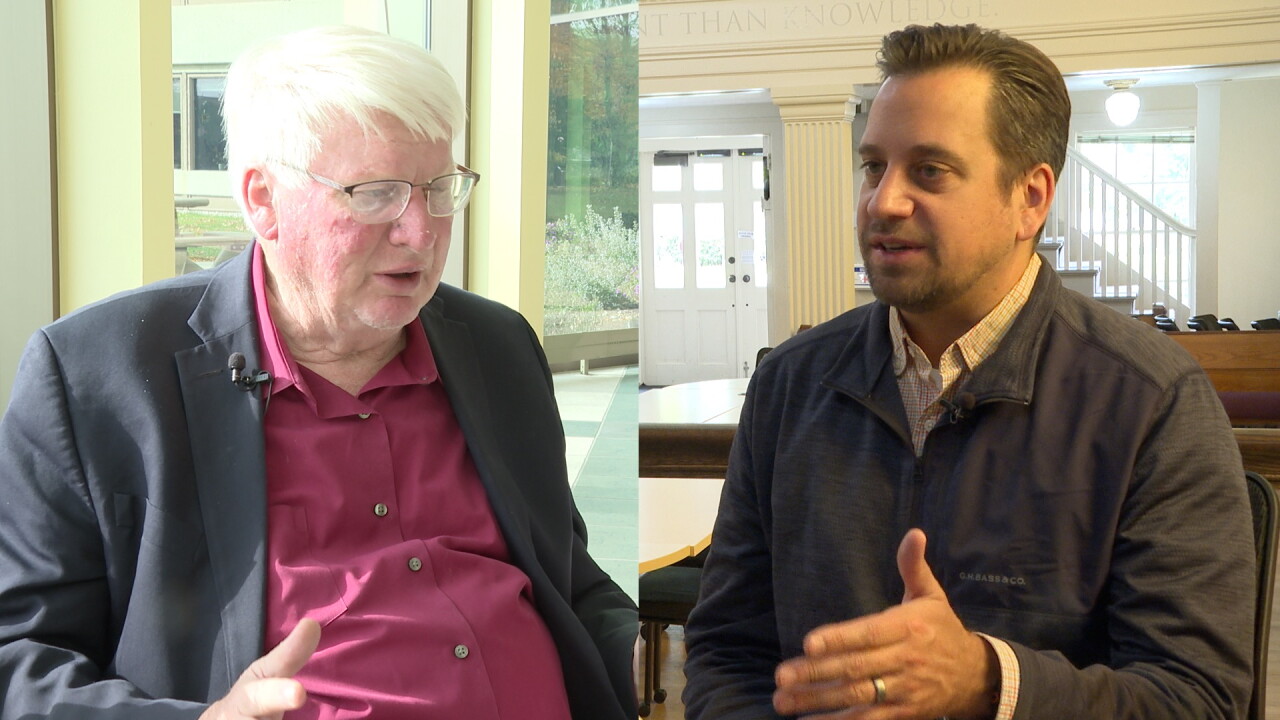


SHEBOYGAN COUNTY, Wis — The ongoing war with Iran, rising fuel prices and the Trump administration’s immigration policies are emerging as key issues in Wisconsin’s 6th Congressional District race, where Republican incumbent Glenn Grothman is seeking to extend his 12-year tenure in Congress.
Grothman faces Democratic challenger Brad Smith, an Army veteran and small-business owner who says the administration’s policies are hurting working families and Wisconsin businesses.
The district includes Sheboygan, Port Washington, Fond du Lac and Oshkosh. Republicans have represented the district since 1967.
Candidates clash over war with Iran
Candidates had different viewpoints on the United States's continued military involvement in Iran, which has raised questions about national security, the cost of the conflict, and its economic consequences.
Grothman defended President Donald Trump’s efforts to negotiate an end to the war, arguing that the U.S. must ensure Iran cannot develop a nuclear weapon before ending its military involvement.
“President Trump is desperately trying to get it to end, negotiate for it to end,” Grothman said.
When asked when he would support ending U.S. military involvement, Grothman said the decision should depend on the nuclear threat, and the war should only come to an end when the U.S. has certainly deterred Iran from getting a nuclear weapon.
Grothman also argued that calls to end the war could weaken the administration’s negotiating position. He said he expects progress toward ending the conflict, potentially after the midterm elections.
Smith, however, called the war unjustified and questioned the administration’s strategy.
"It is wreaking havoc on our economy, and there is no clear strategy," Smith said.
Smith, who served overseas during the Iraq War, said the conflict places additional burdens on military families and service members. He also questioned the administration’s explanation for entering the war, pointing to earlier statements that Iran’s nuclear program had been destroyed.
“I think there is an extreme lack of clarity and lack of transparency, which is exactly why we shouldn’t be involved in something like this unless we have, you know, confirmation and transparency,” Smith said.
Rising gas prices put pressure on Wisconsin families
The conflict has also intensified concerns about the cost of living, particularly gasoline and diesel prices that affect commuters, farmers and businesses. According to AAA figures cited during the interviews, Wisconsin’s average gas price reached $4.52 per gallon, above the national average.
As of Oct. 26, the national average price under Trump’s second administration had also surpassed the average recorded under the Biden administration, according to the figures cited in the report.
Grothman said he hopes higher prices will not persist, but argued that expanding domestic oil production and refinery capacity is necessary to bring costs down over the long term.
“I’m sure we all wish that gas prices were lower,” Grothman said.
He identified additional refineries as a key part of his proposed solution, arguing that limited refining capacity is a major bottleneck in the U.S. fuel supply. He also said ending the war could help lower prices.
Grothman added he would consider temporarily using federal general-fund revenue to offset gas taxes if necessary, rather than directing those taxes toward highway projects.
Smith argued that the war itself is a major driver of higher fuel prices because oil is traded on a global market.
“I would stop the war in Iran,” Smith said, pointing to the importance of shipping routes in the region to the world’s oil supply.
He also criticized Trump’s tariffs, saying they are increasing costs for consumers and businesses across multiple industries. Smith said broad tariffs have created uncertainty for companies trying to plan investments and hiring. He pointed to retaliatory Canadian tariffs affecting Wisconsin industries, including dairy, whey products, paper and industrial machinery.
The candidates’ disagreement reflects a broader divide over how to address rising costs: Grothman emphasized increasing domestic energy supply and refinery capacity, while Smith called for ending the war and reversing broad tariffs.
Immigration policies and Wisconsin’s agricultural workforce
Immigration was another major point of disagreement, particularly over the effects of federal enforcement on Wisconsin’s farms and rural communities. Smith argued that the Trump administration’s immigration policies are hurting the state’s economy by disrupting access to workers relied upon by agricultural businesses.
“It’s damaging to Wisconsin’s economy right now,” Smith said. “80% of our farms depend on trusted immigrant labor.”
Smith said he has heard concerns from conservative farmers and traditional Republican voters who believe current policies are not working. He also argued that existing immigration programs do not adequately account for Wisconsin’s dairy industry, where work is needed year-round rather than only during seasonal periods.
Pointing to the federal H-2A visa program, which is designed for temporary agricultural workers, he described it as a gap in the immigration system.
“If you know dairy farming here in Wisconsin, that is absolutely not seasonal. It is 24/7, 365 days a year,” Smith said.
He called for reforms that would allow farm workers to obtain legal status and remain in the country to work over the long term.
“I think we need to do a lot of work to improve that and give them a legal pathway to stay,” Smith said.
Grothman defended the administration’s stricter approach to immigration, arguing that the U.S. cannot sustain unlimited immigration and that federal authorities face significant challenges enforcing existing laws. He said he supports securing the border and reducing illegal immigration, while arguing that the number of people born outside the U.S. has reached historically high levels.
Grothman also distinguished between legal and illegal immigration, saying legal immigrants often succeed economically and that people who follow legal procedures may resent those who enter the country unlawfully.
“All these people are coming here and succeeding better than the native born. My goodness,” said Grothman.
Grothman said he supports changing immigration laws to prioritize applicants he considers desirable and restricting access to welfare benefits for noncitizens, including permanent residents.
The candidates offered different approaches to the issue: Grothman emphasized enforcement and restrictions on public benefits, while Smith focused on the economic consequences of current enforcement policies and expanding legal pathways for workers.
Grothman praises Trump administration, Smith calls it a failure
The candidates also offered sharply different assessments of Trump’s second term.
Grothman praised the administration’s efforts to eliminate diversity, equity and inclusion programs, strengthen border security and reduce the federal workforce. He also pointed to what he described as a more business-friendly regulatory environment. However, Grothman said he disagrees with Trump on tariffs and believes the president’s public remarks sometimes hurt his own political image.
“I do feel he comes across a little egotistical, and it hurts his policies by doing that,” Grothman said.
Smith delivered a much harsher assessment, calling the administration’s second term “an abject failure.” He argued that the president has focused on personal legacy projects instead of the financial challenges facing American families.
“He’s more focused on this arch and this ballroom and putting his name in the Kennedy Center and concerned over those things while our people are struggling to feed their families and be able to even afford to drive to work,” said Smith.
Smith also criticized the administration’s tariffs, arguing that they have increased business costs and created uncertainty for Wisconsin employers.
The candidates’ differing views on Trump reflect their broader policy disagreements over the economy, immigration and the federal government’s role in addressing problems affecting local communities.
Data center development raises transparency concerns
Both candidates expressed concerns about local governments signing nondisclosure agreements related to data center projects, including developments in the Port Washington area. Grothman said he supports transparency in local government and questioned why public officials would enter into agreements that prevent residents from seeing the terms.
“I can’t imagine why we would have public officials entering into contracts that the public could not see,” Grothman said.
He said he generally favors local control and believes Wisconsin should address state and municipal issues, although he would consider supporting legislation requiring greater transparency.
Smith called for stronger regulatory protections for communities affected by data center development. He raised concerns about limited public input, potential environmental impacts, utility costs and tax incentives provided to large technology projects.
Smith also argued that Congress should strengthen protections for local governments’ ability to regulate artificial intelligence and related developments.
“I want to make sure we push more to local control,” Smith said.
While both candidates questioned the use of nondisclosure agreements, they differed on the broader role of federal regulation and how much oversight data center projects should face.
As the race continues, the candidates are presenting voters with contrasting approaches to the issues affecting Wisconsin families, from the cost of filling up a gas tank to the future of the state’s agricultural workforce.
It’s about time to watch on your time. Stream local news and weather 24/7 by searching for “TMJ4” on your device.
Available for download on Roku, Apple TV, Amazon Fire TV, and more.