




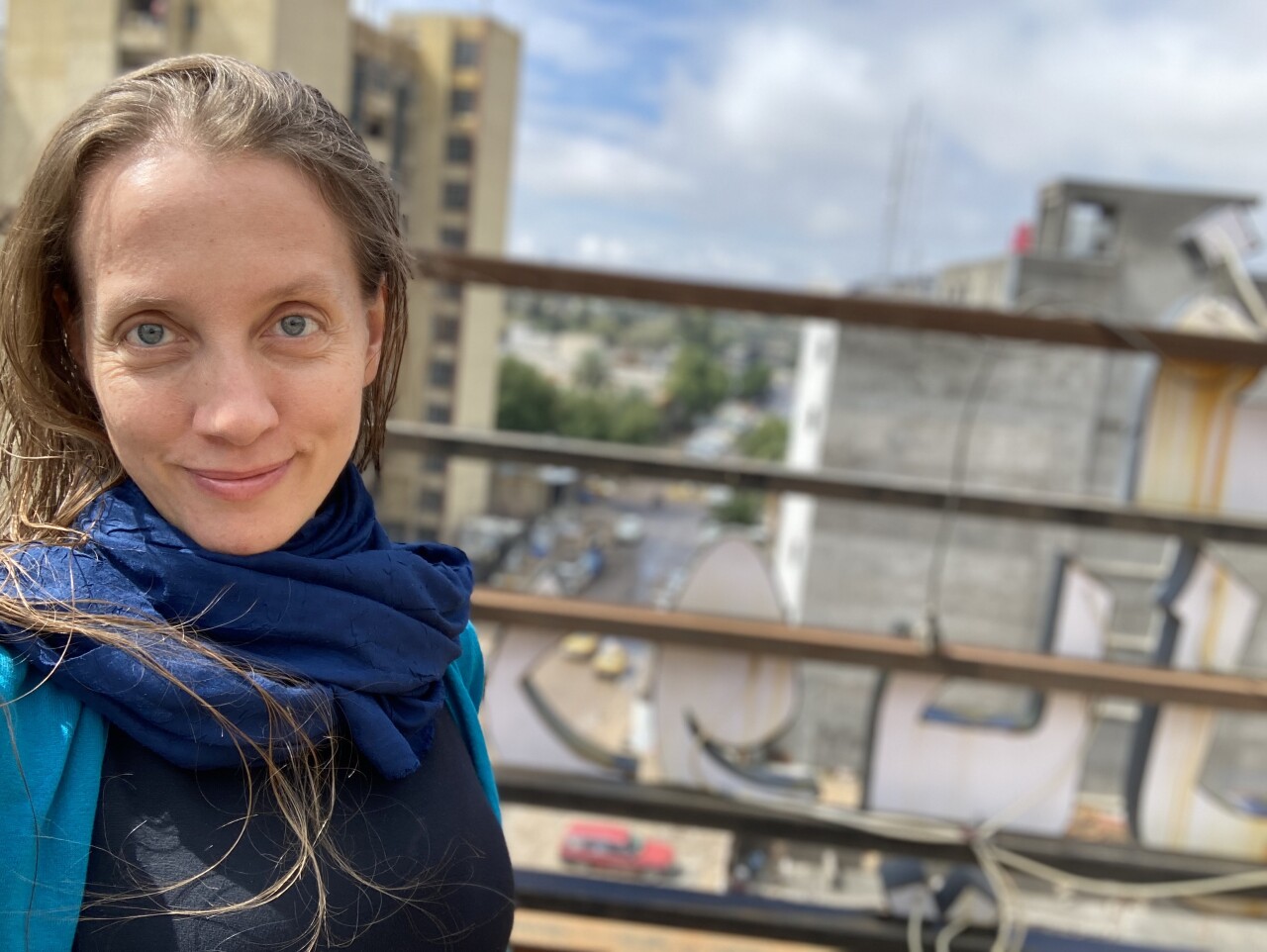
Wisconsin-native journalist, Shelly Kittleson, who was kidnapped and held hostage in Iraq, has opened up about her time in captivity.
"I remember screaming, though I don't know what words I screamed," Kittleson wrote in a piece for The Atlantic. "And I remember resisting, though there was little I could do in heels against two military-trained men intent on shoving me into the back seat of their vehicle."
Kittleson described how, in the moment that was seen via video surveillance, she struggled as two men walked past and watched it all happen.
WATCH: Wisconsin-native journalist Shelly Kittleson described her time in captivity in Iraq
When she was put inside the vehicle, the men zip-tied her wrists and ankles and had her blindfolded. "I kept asking them: Why?" she wrote.
Kittleson had been working in Iraq since 2014, documenting the fight against the Islamic State from the front lines as a freelancer. Covering everything from social and politics to economics and environmental issues.

She explained how she had been welcomed into the homes of Iraqi families whose stories she had told with sensitivity and fairness.
She then tried to ask the men, in Arabic, why they had taken her, why they were hurting her, and what purpose this served for them.
In the little English he knew, one yelled for her not to speak. He then continued to punch her on her side and back. Something was also put over her head, making it harder for her to breathe and move.
She was forced onto the floor of the vehicle behind the driver's seat and was continuously beaten. She began to pray softly in Arabic, which then led to more beatings and her loss of consciousness.
She was dragged out of the vehicle at one point, her knees scraping the ground. The stockings she was once wearing were being used as a blindfold.
Kittleson described the sounds around her, which led her to think that she was in an urban area. Her legs were spread and her body was searched. She described the pain she was in, which she had later learned was caused by broken ribs. She had been told that she would be killed if she made any noise.
She was then given a little bit of hope when a man said, "But she's a woman."
Kittleson then goes on to describe the day she was kidnapped.
She had stopped by an outdoor tea shop where older Iraqi men would chat and network. She went back to her budget hotel, changed into heels and more formal clothes, as she was supposed to be meeting with an Iraqi government official that day, one whom she had known for years.
She was grabbed off the street when she was waiting for a taxi to take her to her meeting.
She then describes the warnings she had received over the years of reporting in Iraq, that she may be targeted for kidnapping or assassination. She describes how there are risks for those in her line of work, and none of the warnings had been followed by any attempts.
Kittleson then said that she had known Iraqis who had been kidnapped or killed in Baghdad. She also knew of Kataib Hezbollah, but did not know for certain if they were the group that had kidnapped her.
In the first location that she was being held at, she remained shackled and was taken out only a few times, blindfolded to use the restroom in another part of what seemed to have been someone's home.
To get in and out of the cell, she would have to crawl through an opening in the door that was about a meter high. She was forced to urinate in the cell one time due to no one coming to open the cell for a long stretch of time.
Kittleson said that her captors would tell her nothing but that she was in "detention" and she was in the "hands of the security forces," and she would be "released in a few days" if she was proven to be innocent.
One day, she woke up to loud booming sounds and the crawl space door opening with a man entering the cell and another standing outside, wielding a knife. They told her to do what they said for her own safety and not speak a word.
She was then blindfolded again with her blood-soaked stockings, her wrists and ankles bound, and was dragged out and shoved into the trunk of a vehicle. She was then moved to a second and a third vehicle before arriving at the next location of her captivity.
The man who gave her hope in the first location was at the second location as well. She was later told that this "group" had taken her from the other "group" on the orders of "their leader".
She explains how differently she was treated at this new location. The blindfold was removed when she was locked in "her room", the zip ties that once bound her wrists and ankles were replaced with handcuffs - allowing her to move around easier. She was able to hear birds. The room was larger than the cell. She described a window in the room that was frosted and half-boarded, but not all the way, so that sunlight was able to peak through and she was able to know day from night.
One darker-skinned man who wore a camouflage balaclava told her that they were "friends now" and told her that if she were to try to see anything outside the window, their "friendship" would end.
She was also told that if she tried to escape, she would be killed.
Kittleson explained how the guards at this location granted her "small mercies" such as yogurt, dates, as much water as she asked for and more frequent bathroom trips. They also conversed in conversations with her.
They gave her an extra blanket to prop up her injured torso and had asked how she liked her eggs and would bring them to her. They also brought her watermelon, claiming it was "good for healing."
"You are innocent, we know that," one of the captors told her. They explained to her that her being kidnapped was due to the war and her having an American passport.
One day, a man brought her shampoo, pink pajamas and a toothbrush and told her that an investigative officer was on his way to determine he fate. He then took off her handcuffs long enough to try and wash herself a bit.
Kittleson then explained that the "interrogation" was a farce and the "confession" was all scripted by the officer who had interrogated her.
She was told that there were accusations against her. She also said that they told her that there were photos of her at the U.S. Embassy in Baghdad and that she had resided at the embassy for months, although she had never visited. They also claimed that she had met with a man from the embassy in recent days and that she had allegedly given him information about the locations of Iran-backed armed factions and advisers.
At one point, the investigative officer informed her that she could either do as she was told, which was to recite a script that he had written, and be released the next day or she could be held for years.
"There are a lot of people outside here that want to kill you," he told her. "And if I walk out that door without the video, I take no responsibility for what happens to you. Your life depends on this. Choose well."
Kittleson described the script as being "consisted of nonsense". She was being told to say that she had information on the leader of Kataib Hezbollah and bases of factions of the Iran-linked Islamic Resistance in Iraq and then relayed that information to U.S. Embassy officials. She was also ordered to say that she had received three months of training from U.S. military officers on intelligence gathering in Syria in 2015.
He then gave her 30 minutes to memorize the script and record it in both English and Arabic. So, she did.
Kittleson wasn't released the following day, but on April 8th when she was handed over in the early-morning hours. She later learned that her suspicions of who her captors were was correct.
She was blindfolded once more and loaded into one vehicle then transferred to another before being handed over tot he official Iraqi-government forces who took her to Baghdad's Green Zone where the president of Iraq's Supreme Judicial Council, Faiq Zaidan, was waiting for her.
Before being handed over the U.S. Embassy, Zaidan told her that she would be welcomed back to Iraq in the future and that he would grant her an interview whenever she returned.
"I have every intention of asking him to keep his word," she wrote at the end.
She was flown to Europe to receive medical treatment by the U.S. Embassy after her release.
She wrote on Facebook on Thursday that she is "incredibly grateful to those who worked for my release when I was held hostage by an armed faction in Iraq earlier this month."
It’s about time to watch on your time. Stream local news and weather 24/7 by searching for “TMJ4” on your device.
Available for download on Roku, Apple TV, Amazon Fire TV, and more.
![SNG_Digital_Ad_480x360_CTA[13].jpg](https://ewscripps.brightspotcdn.com/dims4/default/765a37a/2147483647/strip/true/crop/480x360+0+0/resize/960x720!/format/webp/quality/90/?url=http%3A%2F%2Fewscripps-brightspot.s3.amazonaws.com%2F7d%2Fdb%2F0b14063144e881c22c4592637e0d%2Fsng-digital-ad-480x360-cta13.jpg)